

Literary Corner*** British Literature /Historical Film – Robert the Bruce on Amazon Prime and Freevee
Set against 14th-century Scotland, in the thick of freezing winter and deep snow, in the middle of nowhere, Robert Bruce, king of England has lost hope after thirty years of fighting against the English that occupied Scotland. After having sent his remaining men home, he is alone, wounded, and spiritless, and collapses in the snow from exhaustion and because of his bleeding chest pierced by an arrow. If he is not helped soon, he will die in an unmarked grave on the snowy mountainside of the country he has sacrificed his life for.
This film is about courage, bravery, heroism, hope, and above all, faith, and love of family and country. A poor family living near the forest in an isolated part of Scotland found and nursed him back to health and, encouraged by their faith in him as their king and in their hope for freedom, their spirit of hard work and loyalty, and seeing through their eyes and struggles and sacrifice the Scotland worth fighting for, he takes up his sword once more and trains the two boys in the family to fight in one-on-one combat. Robert fought with William Wallace before and had wanted to carry on “The Braveheart” legacy. But some of the Scottish had become blinded with greed for money: there was a prize of fifty gold coins on his head (which during the Middle Ages was enough to make a man rich) and some decided to be Judases.
O precious metal,
how blinding thine glitter –
Thou can entice men’s hearts
to forsake the truth,
the ideal of liberty!
However, God is always with the righteous and the just cause. At the right moment, Robert and his “new family” that saved him, find the loyal Scottish men ready to fight alongside their king. Under his leadership, the brave men drove the English away and finally, England recognized Scottish independence under King Robert I, who ruled Scotland from 1306 to 1329 (www.royal.uk > robert. Accessed January 13, 2024).
Robert the Bruce is an example of medieval British literature set into a motion picture. It has the characteristic elements of medieval culture and spirituality, minus castles and palaces, because King Robert chose “to live not in a castle but among the people he fought with” (epilogue of the film).
Set against 14th-century Scotland, in the thick of freezing winter and deep snow, in the middle of nowhere, Robert Bruce, king of England has lost hope after thirty years of fighting against the English that occupied Scotland. After having sent his remaining men home, he is alone, wounded, and spiritless, and collapses in the snow from exhaustion and because of his bleeding chest pierced by an arrow. If he is not helped soon, he will die in an unmarked grave on the snowy mountainside of the country he has sacrificed his life for.
This film is about courage, bravery, heroism, hope, and above all, faith, and love of family and country. A poor family living near the forest in an isolated part of Scotland found and nursed him back to health and, encouraged by their faith in him as their king and in their hope for freedom, their spirit of hard work and loyalty, and seeing through their eyes and struggles and sacrifice the Scotland worth fighting for, he takes up his sword once more and trains the two boys in the family to fight in one-on-one combat. Robert fought with William Wallace before and had wanted to carry on “The Braveheart” legacy. But some of the Scottish had become blinded with greed for money: there was a prize of fifty gold coins on his head (which during the Middle Ages was enough to make a man rich) and some decided to be Judases.
O precious metal,
how blinding thine glitter –
Thou can entice men’s hearts
to forsake the truth,
the ideal of liberty!
However, God is always with the righteous and the just cause. At the right moment, Robert and his “new family” that saved him, find the loyal Scottish men ready to fight alongside their king. Under his leadership, the brave men drove the English away and finally, England recognized Scottish independence under King Robert I, who ruled Scotland from 1306 to 1329 (www.royal.uk > robert. Accessed January 13, 2024).
Robert the Bruce is an example of medieval British literature set into a motion picture. It has the characteristic elements of medieval culture and spirituality, minus castles and palaces, because King Robert chose “to live not in a castle but among the people he fought with” (epilogue of the film).
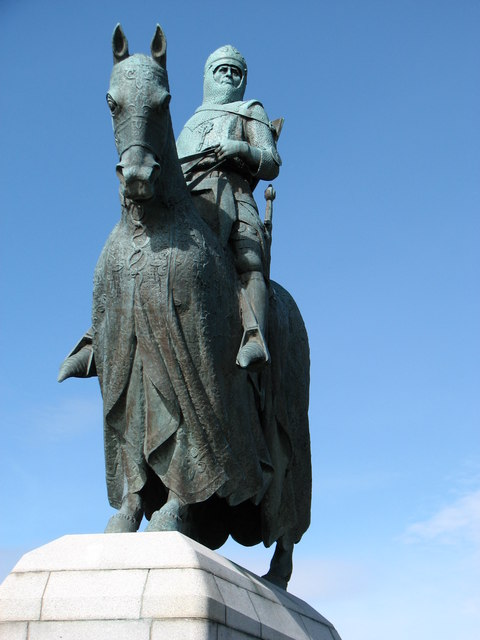
Photo credit: Mark Hope in Google Pixes
 The Journey Through Literature
Leave a comment